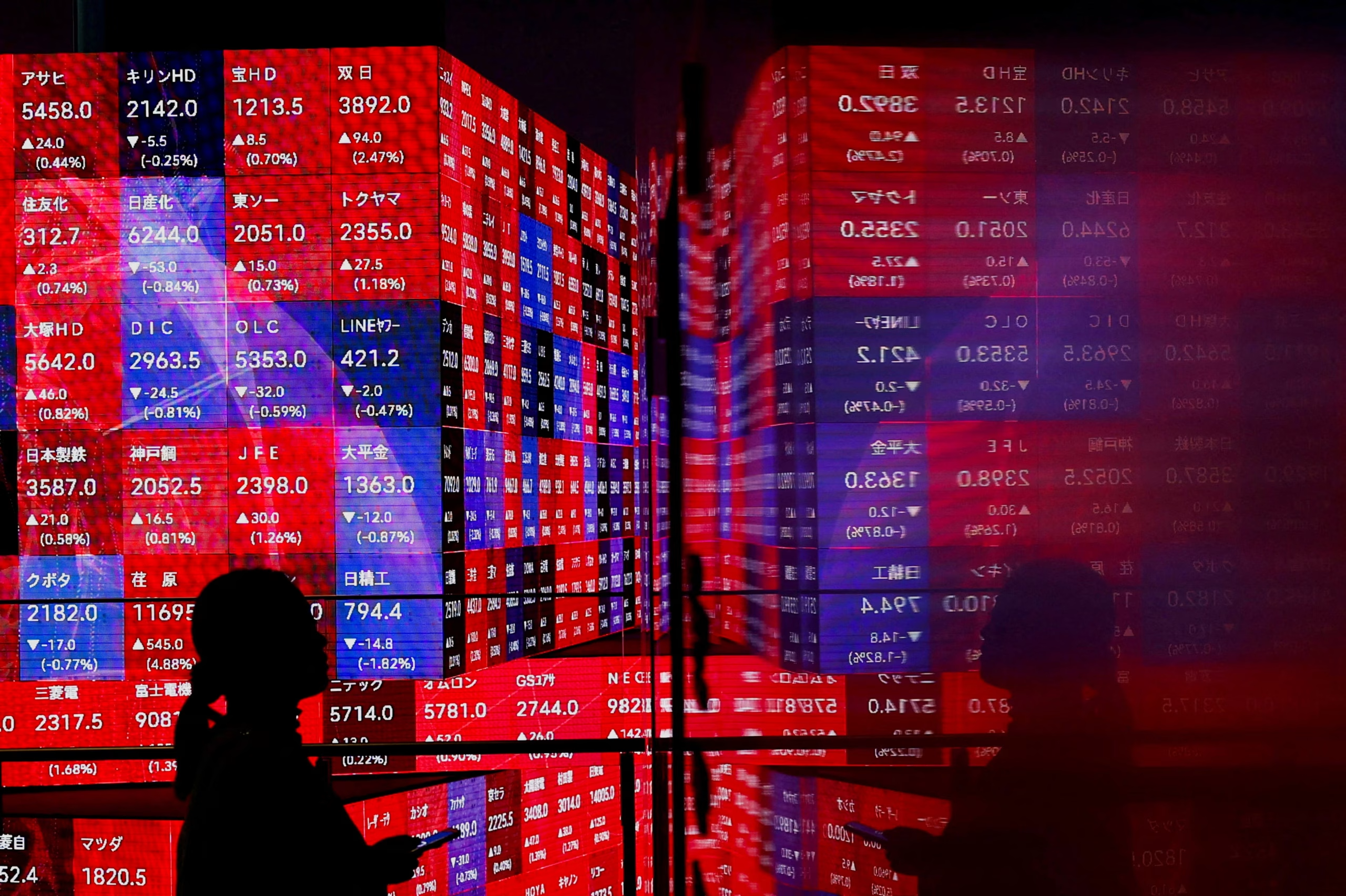
Asian stocks fall sharply on Wednesday as the United States and Iran exchanged their heaviest fire since the ceasefire reached back in April, rattling investors and sending shockwaves across global markets. The renewed conflict has revived fears of wider instability in the Middle East, even as some asset prices behaved in unexpected ways.
What Triggered the Sell-Off
The latest flare-up began after the US launched strikes against Iran, with President Donald Trump blaming Tehran for shooting down a US army helicopter near the strait of Hormuz. Iran responded with a wave of retaliatory attacks early Wednesday, claiming to have targeted Kuwait, Bahrain, and Jordan.
The reaction in Asian equity markets was swift:
- Japan’s Nikkei index slid 2%.
- South Korea’s tech-heavy Kospi plunged around 6%, though it remains up more than 70% for the year so far.
The sharp drop in the Kospi underscored how exposed technology-driven markets are to sudden geopolitical shocks.
Oil Defies Expectations
Despite the escalation, oil prices did not spike as many might expect during a Middle East crisis. Brent crude, the international benchmark, actually edged down 0.2% to $91.28 a barrel.
Just a day earlier, Brent briefly slipped below $90 for the first time since mid-April before recovering somewhat after Trump vowed retaliation. The relatively calm response suggests traders are no longer betting on a dramatic widening of the conflict.
A Market Caught Between Two Fears
According to Jim Reid at Deutsche Bank, investors are wrestling with more than just the Middle East. He noted that markets are also caught between two competing moods: a wave of 1999-style enthusiasm over artificial intelligence on one side, and 2000-era fears of a tech crash on the other.
That tension was visible in the chip sector. The Philadelphia Semiconductor Index dropped as much as 8.62% during intraday trading before clawing back to close down just 1.93%.
European markets, meanwhile, looked set for a far quieter open. Futures for the FTSE 100 pointed to a slight 0.1% dip, with EuroStoxx 50 futures also down 0.1%.
China’s Inflation Surprise
Away from the conflict, fresh data from China added another layer to the global picture. The country’s factory gate prices rose at their fastest pace in four years, fueled by a sharp jump in energy costs linked to the war in Iran.
China’s producer price index climbed 3.9% in May from a year earlier, beating the 3.8% forecast in a Reuters poll and well above April’s 2.8% rise. It marked the third straight monthly increase and the strongest growth since July 2022.
Economists at Pantheon Macroeconomics cautioned against reading too much into the numbers, describing the rebound as mainly a cost-driven story rather than evidence of stronger demand.
Senior China economist Kelvin Lam expects this reflation to continue in the near term, driven by the lasting effect of the war on imported energy costs and the fading drag from last year’s negative carry-over, a factor he says many overlook. He added that while oil and gas futures markets are no longer pricing in further escalation, uncertainty around peace talks and the reopening of the strait of Hormuz is likely to linger.
Lam also pointed out that monthly momentum slowed noticeably, easing to 0.5% from 1.7% the previous month. He attributed this to two factors: global energy markets no longer anticipating a broader conflict, with a $150-per-barrel scenario now looking unlikely, and China’s relative insulation from inflation pass-through, where weak domestic demand makes it harder for producers to lift prices.
The Day Ahead
Several key events are set to shape sentiment through the trading day:
- 9am BST: Deadline for the CMA and Ofcom to report back to the government on the Telegraph/Mail deal.
- 1.30pm BST: US inflation data for May, forecast to climb to 4.2%.
- 2.15pm BST: Treasury Committee hearing on student loans.
With geopolitical risk, inflation worries, and the ongoing AI-versus-crash debate all colliding at once, markets face a tense and unpredictable session ahead. For now, the sharp fall in Asian stocks serves as a reminder of just how quickly global sentiment can shift when conflict and economic uncertainty meet.
Author