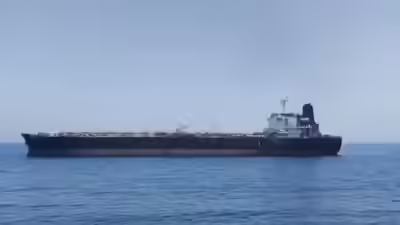
The news of Indian sailors killed in a US strike has sent a wave of grief and diplomatic friction through New Delhi, after authorities confirmed Thursday that three seafarers died in an American military operation to halt a tanker off Oman. The deaths mark the first fatalities since Washington began its blockade of Iran-linked shipping, intensifying a confrontation with significant geopolitical stakes.
The First Deaths of the Blockade
The three sailors lost their lives as part of U.S. efforts to stop ships connected to Iran. These are the first reported deaths since the blockade began on April 13, an operation that has seen American forces disable eight vessels and turn back more than 100 others.
Indian Shipping Minister Sarbananda Sonowal confirmed the deaths, explaining that three Indian seafarers initially reported missing had now been confirmed dead after their bodies were located and identified.
How the Strike Unfolded
The U.S. military’s Central Command, known as Centcom, said an American aircraft carried out a precision strike on the Palau-flagged oil products tanker Settebello in the Gulf of Oman. According to Centcom, U.S. forces fired precision munitions into the ship’s engine room after the crew repeatedly failed to comply with directions from American forces.
Centcom maintained that the Settebello had violated the ongoing blockade by attempting to transport oil from Iran. India’s foreign ministry condemned the attack on Wednesday and noted that 21 Indian sailors had been rescued from the vessel.
The aftermath required an international rescue response. According to British maritime risk management group Vanguard, the Omani Navy responded to the Settebello’s distress call after it reported an engine fire following the U.S. strike.
India Lodges a Strong Protest
The deaths prompted a sharp diplomatic reaction from New Delhi. Two Indian sources told Reuters that India summoned the U.S. deputy chief of mission after lodging a strong protest over the incident.
The timing is especially sensitive. The U.S. attacks on vessels carrying Indian seafarers come just ahead of next week’s Group of Seven summit, where Indian Prime Minister Narendra Modi is expected to hold bilateral talks with U.S. President Donald Trump. The deaths now risk casting a shadow over what was anticipated to be a discussion on trade and other bilateral matters.
A Family’s Grief
Behind the diplomatic headlines lies profound personal loss. Family members of Shivanand Chaurasia, one of the sailors who died, told reporters he had gone to sea about nine months ago. In a heartbreaking detail, they said he had reassured his father earlier this week that everything was fine.
A Second Tanker Incident
The crisis appears to be widening. Separately, the Indian embassy in Oman reported on Thursday another incident involving a different tanker off the coast of Oman, adding to concerns about the safety of vessels in the region.
This was not the first such episode involving Indian crew either. U.S. forces had disabled the unladen Marivex oil tanker, which also carried Indian sailors, in the Gulf of Oman on Monday after it attempted to sail to an Iranian port.
The Scope of the Blockade
The U.S. operation has been sweeping in its reach. According to Centcom, the blockade has disabled eight non-compliant vessels, redirected 134 ships that complied, and allowed 42 vessels supporting humanitarian aid to pass.
The ships targeted include Iranian vessels as well as so-called shadow fleet tankers. These are typically older ships operating without Western insurance, used to move sanctioned oil while sailing under the flags of various nations to obscure their true ownership, cargo, and movements.
India’s Stake in Global Shipping
The deaths underscore India’s outsized role in the maritime industry. India is the world’s third-largest supplier of seafarers, with more than 300,000 sailors working across global shipping fleets, according to government data. That heavy presence means Indian crews are disproportionately exposed when conflict disrupts key shipping lanes.
International Condemnation
The incident drew a forceful response from the maritime community. Arsenio Dominguez, secretary-general of the UN’s shipping agency, the International Maritime Organization, strongly condemned any action by any party that endangers the lives of seafarers and the safety of international shipping, calling it simply unacceptable.
An Uncertain Path Forward
As India mourns its lost sailors and presses Washington for answers, the broader confrontation over Iran-linked shipping shows little sign of easing. With a second tanker incident now reported and the G7 summit looming, the deaths of these three seafarers have transformed a maritime enforcement campaign into a delicate diplomatic flashpoint between two nations with much to lose.
For the families of those killed and the hundreds of thousands of Indian sailors working in dangerous waters, the tragedy raises urgent questions about how the safety of civilian crews can be protected amid an escalating geopolitical struggle.
Author