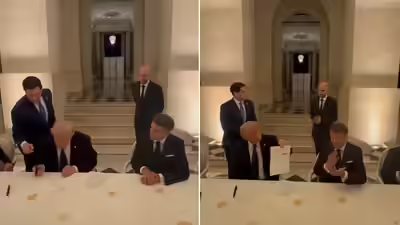
The US-Iran agreement has officially been sealed, marking one of the most significant diplomatic moments of 2026. On the evening of June 17, President Donald Trump put pen to paper at the historic Palace of Versailles in France, declaring simply to reporters, “It’s signed.” The announcement came shortly after a dinner hosted by French President Emmanuel Macron, capping weeks of tense negotiation.
What makes this US-Iran agreement remarkable isn’t only its content, but the weight of the location where it was finalized — a palace that has witnessed the making and unraveling of history before.
A Deal Forged at Versailles
Trump signed the document following the Macron-hosted gathering tied to the G7 summit. According to photographs released by Iranian state media, Iranian President Masoud Pezeshkian also added his signature, confirming that both nations had committed to the terms.
The setting was no accident. The grandeur of Versailles lent ceremonial gravity to an accord that both leaders hope will reshape relations between Washington and Tehran for years to come.
What the Agreement Actually Says
The memorandum lays out a roadmap that touches energy, security, and regional stability. Several core commitments stand out:
- Oil exports resume: The United States agreed to issue waivers allowing Iran to return to selling oil on the global market, a major economic lifeline for Tehran.
- The Strait of Hormuz reopens: The text includes detailed provisions for restoring traffic through this vital shipping corridor, through which a large share of the world’s oil passes.
- A nuclear pledge: Iran formally committed that it will not pursue or build nuclear weapons.
- A massive rebuilding fund: The US and several regional partners agreed to work toward a $300 billion reconstruction fund for Iran. The specifics will be hashed out in the next round of talks.
Beyond the bilateral terms, the agreement reaches further. Its language brings an end to hostilities across multiple fronts — including Lebanon, where Israeli strikes had continued even as negotiations advanced.
A Haunting Historical Parallel
Here’s where the story takes on an unsettling layer. Trump chose to sign this US-Iran agreement in the exact spot where another American president once signed a treaty that historians blame for his political collapse and, eventually, the rise of Adolf Hitler.
Roughly 107 years earlier, on June 28, 1919, President Woodrow Wilson signed the Treaty of Versailles to bring World War I to a close. Co-signed by allies France and Britain, the treaty formally ended four years of brutal fighting against Germany and its partners.
But the deal was troubled from the start.
Why the Original Versailles Treaty Failed
Rather than a true negotiation, the terms were essentially imposed on Germany. The conditions were severe and humiliating:
- Germany had to accept full blame for starting the war.
- It lost more than 26,000 square miles of territory.
- It owed close to $5 billion in reparations.
- It surrendered its overseas colonies.
- Its military was sharply restricted in size and capability.
German delegates objected fiercely, ultimately signing only because an allied invasion was threatened within days. That bitterness lingered for years. Adolf Hitler later seized on the public’s anger over the treaty to build his following. Once in power, he tore up the agreement and rearmed Germany — steps that helped pave the road to World War II.
Wilson’s Downfall
The treaty’s troubles weren’t confined to Europe. In the United States, Wilson’s signature achievement — the creation of the League of Nations — sparked deep resistance in Congress and among ordinary Americans. Many feared the League would entangle the country in distant conflicts it had no business joining.
Ratification failed not once but twice, in 1919 and again in 1920, effectively killing the treaty’s prospects in America. By 1921, Washington had abandoned the original document altogether and signed a separate peace deal with Germany.
Wilson refused to give up easily. He launched an exhausting nationwide campaign to win public support, traveling more than 10,000 miles during the summer of 1919, according to the University of Virginia’s Miller Center. The strain proved devastating. On October 2 of that year, he suffered a severe stroke that left him incapacitated for the rest of his presidency.
History Watching Over a New Promise
The symbolism of signing the US-Iran agreement at Versailles is impossible to ignore. The same halls that once hosted a peace meant to end “the war to end all wars” — but instead sowed the seeds of the next one — now host a fresh attempt at reconciliation in the Middle East.
Whether this agreement avoids the fate of its 1919 predecessor will depend on what happens after the cameras leave. The Treaty of Versailles failed not because of its signing ceremony, but because of what came afterward: resentment, broken promises, and political resistance at home.
The US-Iran agreement faces its own version of those tests. The $300 billion reconstruction fund still needs to be built. The nuclear commitments need verification and trust. Regional partners must stay aligned. And as Wilson’s experience showed, even the most ambitious international deals can collapse if domestic support evaporates.
What Comes Next
For now, the focus shifts to implementation. The next phase of negotiations will determine how the reconstruction fund is structured, how oil exports are monitored, and how the ceasefire holds across the region, especially in Lebanon.
Optimists see a genuine turning point — a chance to cool one of the world’s most dangerous flashpoints. Skeptics point to the long history of fragile Middle East agreements and the cautionary tale baked into the very walls where this one was signed.
What’s certain is that the US-Iran agreement has already made history. The question that lingers, echoing down the corridors of Versailles, is whether it will be remembered as a lasting peace — or another well-intentioned promise that the future failed to keep.
Author