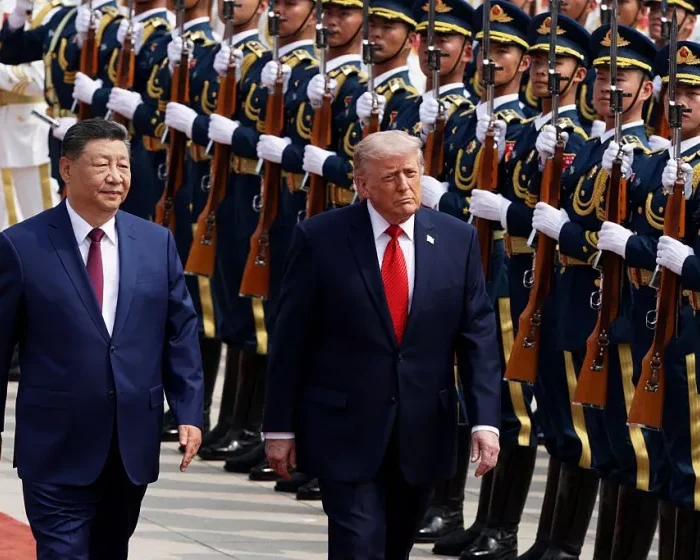
Trump’s Iran deal took center stage this week as the President defended a newly signed agreement, warned of renewed military action, and made a striking admission: he was determined not to let economic disaster define his legacy. Speaking on the sidelines of the G7 Summit in Évian, France, Donald Trump framed the memorandum of understanding (MOU) with Iran as a move to head off financial ruin while keeping the threat of force firmly on the table.
A Deal Driven by Economic Fears
For Trump, the stakes weren’t only about nuclear weapons or regional stability. They were about the American economy and, by extension, his own place in history.
The President invoked the name of Herbert Hoover, the 31st U.S. president widely associated with the onset of the Great Depression, to explain his urgency. Trump made clear that being remembered the way Hoover is remembered was something he wanted to avoid at all costs.
“I didn’t want to see economic catastrophe,” he told reporters, suggesting that a prolonged conflict could have dragged the country toward a depression. He pointed to the stock market’s reaction as proof that peace paid off, noting that markets surged every time negotiations gained momentum.
In short, Trump tied the diplomatic breakthrough directly to financial confidence, presenting the deal as both a foreign policy win and an economic safeguard.
Big Claims, Few Details
Despite the dramatic framing, specifics were in short supply. Trump described the agreement as “historic” and “strong,” yet offered little concrete information about what it actually contained.
Adding to the confusion:
- The White House had not released the text of the agreement.
- Senior U.S. officials read portions of the deal aloud to reporters during the same window the President was speaking.
- Trump himself did not walk through the actual terms in his remarks.
This gap between bold rhetoric and hard detail left observers piecing together the agreement’s scope from fragments rather than an official document.
The Threat That Came With the Deal
Even as he celebrated the agreement, Trump made sure to keep a warning attached to it. His message to Tehran was blunt: comply, or face military consequences.
He indicated that if obligations weren’t met within a 60-day window, the U.S. would simply resume bombing. While he insisted he had no desire to return to airstrikes, he framed it as a non-negotiable backstop, repeating that the United States would never permit Iran to acquire a nuclear weapon.
According to Trump, Iran has agreed to those terms, and that commitment, he said, would be visible in the agreement itself.
When pressed on whether the deal included enforceable penalties, Trump brushed the question aside. To him, the enforcement mechanism was straightforward and required no legal language: violations would be answered with force, not lawsuits.
“What else am I going to do? Take you to court?” he asked rhetorically, making it clear he viewed military pressure as the only credible deterrent.
A Surprising Stance on Missiles
One of the most notable moments came when Trump signaled openness to letting Iran keep its stockpile of ballistic missiles, a position that surprised many.
His reasoning centered on fairness. Trump argued that it made little sense to bar Iran from possessing missiles when its regional neighbors already had them.
He pointed specifically to Gulf nations like Saudi Arabia and Qatar, suggesting that denying Iran similar weapons created an uneven standard. In his view, if surrounding states were armed, Iran having “some” missiles, in proportion, wasn’t unreasonable.
Trump also drew a clear line between conventional weapons and nuclear capability, stressing that a ballistic missile is not the same as a nuclear warhead. To address these conventional concerns, he said the U.S. would pursue a separate, parallel effort with Gulf nations focused on non-nuclear issues.
Softening on Civilian Nuclear Power
Perhaps more unexpected was Trump’s shift in tone regarding Iran’s potential civilian nuclear ambitions.
Throughout negotiations, blocking Iran’s path to a nuclear weapon had been one of his central demands. Yet during the press conference, he appeared more flexible about the idea of Iran maintaining a nuclear program for peaceful, electricity-generating purposes.
Trump acknowledged he had long questioned why Iran would even need nuclear power, given its vast oil reserves, which he described as among the largest in the world. Still, he conceded that some electricity needs could justify a limited program.
Once again, his reasoning leaned on regional comparison. Trump suggested it was difficult to deny Iran something that neighboring states already possessed, especially when framed around basic needs like electricity. “You have to use a little common sense,” he said.
What the Agreement Reveals About Trump’s Approach
Taken together, Trump’s remarks paint a picture of a leader balancing several competing instincts at once:
- A desire to claim a major diplomatic victory.
- A reluctance to spell out enforceable details.
- A willingness to compromise on missiles and civilian nuclear power.
- An unwavering threat of military action as the ultimate guarantee.
The result is an agreement built less on rigid legal terms and more on personal deterrence, with Trump positioning himself as both dealmaker and enforcer.
The Bottom Line
The Trump Iran deal reflects a foreign policy style defined by flexibility on some fronts and hardline pressure on others. By tying the agreement to economic stability and invoking the ghost of Herbert Hoover, Trump signaled just how much he viewed this moment as central to his legacy.
Whether the deal holds, however, may depend less on its written terms and more on Iran’s calculation of how serious Trump is about following through on his promise to “bomb the hell out of them” if they stray. For now, the agreement stands as a high-stakes gamble, one where diplomacy and the threat of war remain tightly intertwined.
Author