The Democratic Party divide is on full display this week, as a wave of progressive primary victories in New York collided head-on with the moderating message many party leaders have been preaching. The tension lays bare a fundamental disconnect: while Washington Democrats push toward the center, the party’s base keeps reaching for candidates further to the left.
A Sympathy Card and a Symbol
The clash was captured in a single, biting gesture. After three leftist candidates in New York City defeated establishment-backed rivals in congressional primaries, a bouquet of flowers and a sympathy card landed at the Capitol Hill office of House Minority Leader Hakeem Jeffries of New York.
The card, sent by House Republicans’ campaign arm, read “With heartfelt sympathy,” a pointed jab at Jeffries, who had backed two of the losing candidates.
Progressives spent Wednesday celebrating, but they may not have been the happiest group of all. Republicans fighting to hold power in the midterms were arguably even more delighted, eager to brand the entire Democratic Party by its loudest socialist voices. Speaker Mike Johnson gleefully declared that “the insurgent left is on the rise,” accusing Democrats of failing to defend against what he called a “Marxist march.”
Caught Between Two Forces
Democrats now find themselves squeezed from opposite directions. Party leaders in Washington are championing moderate candidates they believe can compete in regions that have grown hostile to Democrats. Meanwhile, primary voters in New York and elsewhere are moving the other way, embracing progressives and even self-described socialists who energize the base.
The New York results, which included the defeat of the chairman of the Congressional Hispanic Caucus, exposed just how little control party power brokers have over their own nominees during a moment of intense voter frustration with the establishment.
Many Democrats believe high prices and Trump’s declining popularity have handed them a clear message centered on affordability. But the danger is familiar. Just two years after Republicans won the White House and Congress partly by painting Democrats as out-of-touch extremists, Trump and his allies are once again working to define the party by its most progressive figures. Early Wednesday, Trump posted that “America the Beautiful will NEVER be a Communist Country,” labeling the three New York winners “solid Communists.”
Where the Energy Is
For all the strategic hand-wringing, the momentum clearly sits with the left. The party has fielded a wide range of candidates, nominating centrists in many swing districts and progressives in urban strongholds. Yet the excitement propelling Democrats lately has come largely from the insurgent wing, a trend that traces back to the massive crowds Senator Bernie Sanders drew during his nationwide “fighting oligarchy” tour.
Representative Ro Khanna, a progressive California Democrat eyeing a 2028 presidential run, called the New York outcome a major win for the progressive movement against the establishment, in what he described as the epicenter of Democratic power.
Notably, many operatives behind the winning New York campaigns cut their teeth working for Sanders or for New York Mayor Zohran Mamdani, the democratic socialist who upended the city’s political establishment with his own election last year.
Defeats in Leadership’s Backyard
What made Tuesday’s results sting more was where they happened, in the home territory of the top Democrats in both chambers.
Two New Yorkers endorsed by Jeffries fell to left-wing challengers:
- Representative Adriano Espaillat, the Hispanic caucus chairman, lost to Darializa Avila Chevalier.
- Representative Dan Goldman lost to Brad Lander.
In a third race, to replace retiring Representative Nydia Velázquez, democratic socialist Claire Valdez defeated Velázquez’s chosen successor.
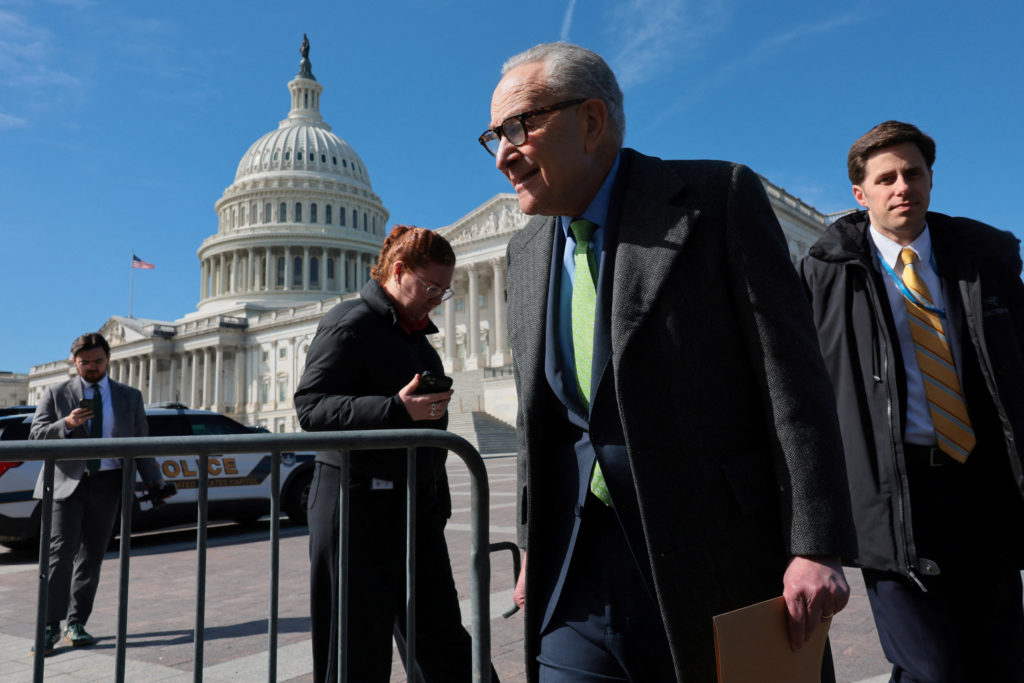
Senator Chuck Schumer, the minority leader, has been backing moderates in an effort to flip Republican-held seats. He is supporting Representative Haley Stevens in Michigan’s August Senate primary against Dr. Abdul El-Sayed, a progressive backed by Sanders. The two differ sharply on Israel, with El-Sayed, like the New York winners, calling its actions in Gaza a genocide. Schumer has already watched one preferred candidate, Maine Governor Janet Mills, suspend her campaign against Sanders-backed newcomer Graham Platner.
The House Democrats’ campaign arm has likewise tried to elevate moderate options in several primaries, only to be rejected by voters in places like California’s Central Valley and rural Maine.
A Mixed Picture, Not a Clean Sweep
The story isn’t entirely one-directional. Moderate Democrats did prevail in some Tuesday primaries, including in Utah and Maryland. In New York’s 17th Congressional District, Democrats nominated combat veteran Cait Conley despite Republican efforts to meddle in the race.
Still, progressives have racked up wins well beyond New York, particularly in cities. Democratic socialist Janeese Lewis George recently won the Democratic primary in Washington, D.C.’s mayoral race.
Democratic strategist Tré Easton suggested the shift may be less about ideology than attitude. There’s a desire, he said, for the old guard to step aside, and anything resembling the party establishment is in trouble.
What the Numbers Reveal
Polling underscores the party’s bind. In the most recent New York Times/Siena College poll, 46 percent of voters said the Democratic Party was “too far to the left,” with the exact same percentage saying Republicans were “too far to the right.”
Yet within the Democratic coalition, socialism itself is surprisingly popular, holding a 49 percent favorable rating against just 22 percent unfavorable among Democrats and Democratic-leaning independents. Strikingly, socialism polled far better than Schumer himself, who registered only a 26 percent favorable rating.
Gabe Tobias, executive director of the Democratic Socialists of America Fund, argued that even non-socialist voters seem willing to give these candidates a chance to govern, crediting democratic socialists with offering a clear explanation for why things feel so broken and what to do differently. He pointed to Mamdani’s affordability agenda as a model for meeting frustrated voters where they are.
A Word of Caution
Not everyone is convinced New York offers a blueprint for the rest of the country. Republicans have repeatedly cast each rising New York progressive, from Alexandria Ocasio-Cortez to Mamdani, as the new face of the Democratic Party. But Ocasio-Cortez proved a skilled communicator and coalition builder, and Trump himself once undercut his own party’s messaging by praising Mamdani in the Oval Office.
Jamie Harrison, former Democratic National Committee chairman, pushed back on loose talk about toppling the establishment. He asked what the word even means, noting that in South Carolina, the establishment is Black voters, and more specifically older Black women.
Harrison warned against treating contests in America’s largest city as representative of the entire party. New York races matter, he acknowledged, but as he put it, New York is not America, and primaries in a deep-blue city shouldn’t be mistaken for the whole of the Democratic Party.
A Party Still Searching for Itself
The competing results leave Democrats without a single, tidy narrative heading into the midterms. The base is hungry for fighters and fed up with the old way of doing things, while leaders worry that lurching left could hand Republicans an easy target. How the party reconciles these forces, especially in upcoming battlegrounds like the Michigan Senate race and the Wisconsin governor’s contest, may well determine not just the midterms but the direction of the Democratic Party for years to come.
Author