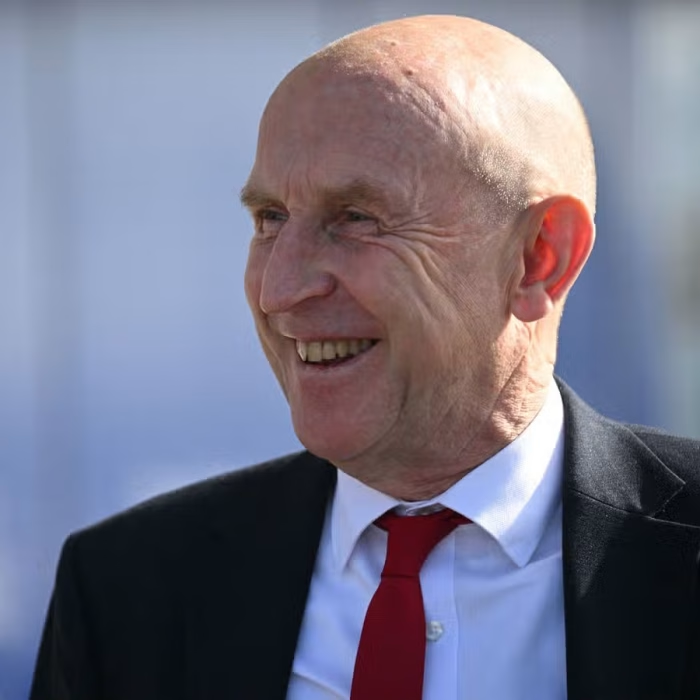
The Graham Platner Senate campaign began as one of the most unlikely political success stories of the cycle and ended just as dramatically. A former Marine and working oysterman with no prior political résumé managed to outmaneuver a sitting governor and assemble a volunteer army of more than 15,000 people across Maine. On Wednesday night, that same campaign came crashing down.
In an eleven-minute video posted to social media, Platner announced he was suspending his bid for the US Senate. The timing was hard to ignore. His decision arrived barely two days after a report surfaced containing accusations from a former partner, who alleged that in 2021 an intoxicated Platner let himself into her home without permission and sexually assaulted her. Platner has firmly rejected the claim.
Still, the damage was immediate and irreversible.
A Rapid Rise, an Even Faster Fall
Platner’s appeal was rooted in his everyman persona. He spoke in a rough, gravelly voice, looked more like a dockworker than a politician, and leaned into a blue-collar identity that many Democrats felt had gone missing from their party. Progressive heavyweights including Bernie Sanders and Elizabeth Warren threw their weight behind him, betting that his authenticity could pry away rural voters who had drifted toward Republicans.
He was positioned as the Democrats’ best shot at unseating Susan Collins, the long-serving Republican senator who remains the lone GOP member of Congress representing a state that backed Democrats in the 2024 presidential race.
For a while, the strategy worked. Despite a long trail of controversy, roughly seven in ten Maine Democrats picked him in June’s primary.
That controversy was substantial and included:
- Old social media posts widely viewed as offensive
- A chest tattoo carrying Nazi-associated imagery
- Sexually explicit messages sent to women after his 2023 marriage
- Accounts from former girlfriends describing him as threatening and toxic
None of it sank him. The latest allegation, however, proved fatal. Within hours of the story breaking, his coalition dissolved. Warren, Sanders, and other progressive allies pulled their support. The national party cut off funding. By midweek, the only real question was timing.
Why This Race Matters So Much
The stakes explain the panic. To seize control of the Senate in the upcoming midterms, Democrats must capture four Republican-held seats while protecting every one of their own. Maine sits near the top of nearly every strategist’s must-win list.
Losing their nominee this late throws that math into chaos. It also drags an old wound back into the open: the ongoing feud between the party’s progressive wing and its establishment.
An Establishment Clash Reignited
In his farewell video, Platner insisted the allegation was not the reason he stepped aside. Instead, he pointed to what he described as forces stripping power away from ordinary supporters. He signaled he would not formally file withdrawal paperwork until he had assurances that his replacement would be chosen through an “open and democratic” process.
That framing set the tone for an ugly standoff. State party chair Devon Murphy-Anderson accused Platner’s team of attempting to “manipulate” the selection process. His camp fired back, arguing they simply wanted to avoid the anointment of another establishment-approved candidate. Notably, Murphy-Anderson also acknowledged Platner’s backers as essential to the party and affirmed their right to help pick his successor.
The friction is not new. It traces back to Platner’s stunning defeat of Governor Janet Mills, the candidate party leaders had personally recruited to challenge Collins. Mills bowed out in April once Platner’s momentum became undeniable.
The Delegate Dilemma
Democrats now face a tight clock. State law requires a replacement before 27 July, and party officials announced they would convene within two weeks, with hundreds of delegates selecting the new nominee.
The worry, according to University of Maine at Farmington political scientist James Melcher, is that Platner’s fired-up base could feel steamrolled. If supporters sense the establishment is once again overriding grassroots enthusiasm, many may simply disengage, taking their energy with them.
Former state senator Lynn Bromley, who had backed Mills, echoed that concern. She praised the youthful energy the campaign unlocked but fears voters won’t have enough time to rally behind a fresh face in just three months. Her deeper anxiety is a losing outcome followed by years of internal blame.
Who Steps In Now
A cluster of more conventional contenders is already circling, several of them fresh off recent statewide or congressional campaigns:
- Troy Jackson, a former Maine Senate leader who ran for governor and finished third
- Nirav Shah, a state epidemiologist who became a familiar face during the pandemic and placed a close second in that same race
- Shenna Bellows, the secretary of state known for challenging federal attempts to access voter data, though she was decisively beaten by Collins in 2014
Each brings recent campaign experience and a measure of name recognition, qualities Platner never had.
The Bigger Picture
Platner embodied a broader trend this cycle, with Democrats repeatedly favoring outsider candidates who promised a bold, combative vision over polished insiders. A victory for him would have offered progressives a powerful proof point: that unapologetic, working-class liberalism could win in a genuine battleground, potentially fueling the case for a left-wing presidential nominee in 2028.
That door now appears shut.
His prolonged survival despite scandal after scandal revealed both the party’s appetite for something different and the danger of elevating untested newcomers who escape scrutiny until the spotlight hits.
Melcher suspects most of Platner’s supporters will eventually fall in line behind whoever replaces him, given how much is riding on the seat. He even floated the idea that this messy chapter could work in the party’s favor, so long as the process doesn’t look like a backroom takeover.
But the obstacle ahead was always steep. Collins has survived thirty years of Democratic challenges, including a well-funded 2020 opponent who led in the polls right up to Election Day. As Melcher put it, beating her was never going to be easy, and it still won’t be.
Author