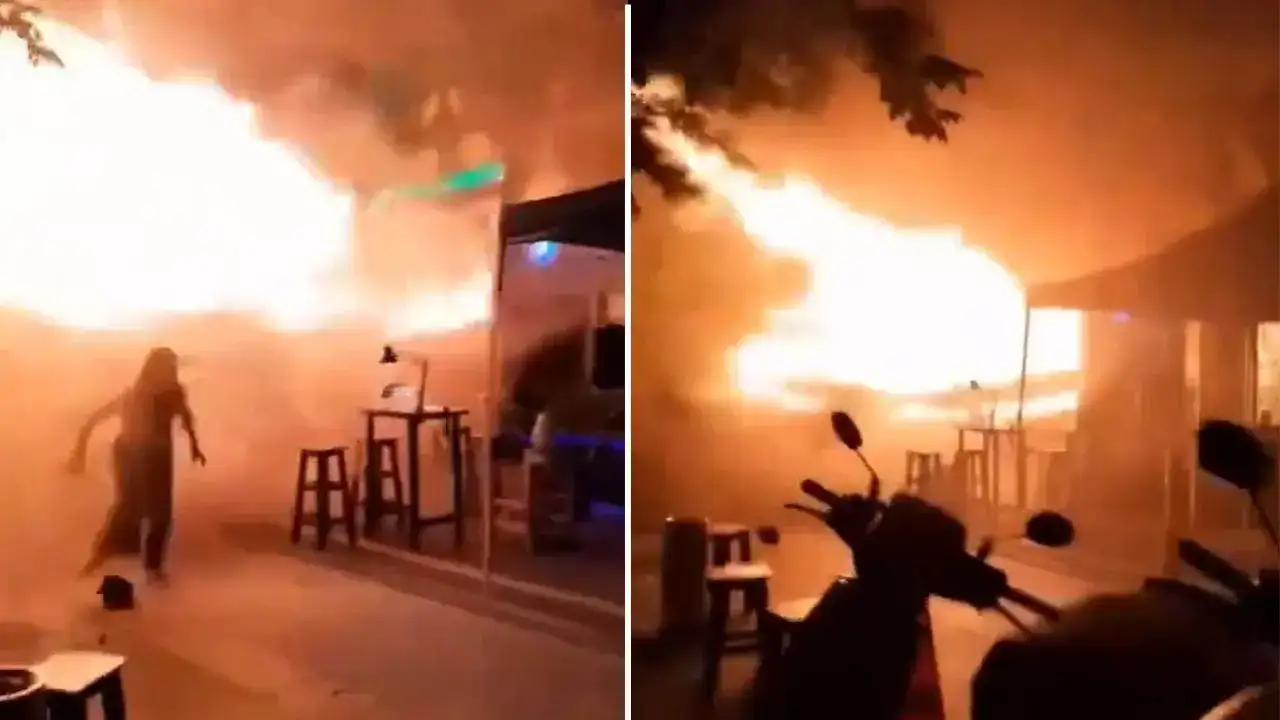
The power cut out first. Then came the explosion, and then the smoke — thick enough that people inside could not find each other, or the way out.
At least 27 people are dead after a Bangkok fire tore through the Na Ladprao beer hall late Sunday night, with dozens more injured and many still unidentified.
Many of the victims were found in the restrooms at the back of the venue.
What Happened
The Bangkok city government said the fire broke out shortly before midnight on Sunday, in the northern part of the Thai capital.
Footage shared online by first responders captured the scale of it — flames raging, plumes pouring from the front door, people fleeing as black smoke climbed into the night sky.
Firefighters brought the blaze under control in roughly thirty minutes. By then, the damage was done.
The Musician’s Account
Prime Minister Anutin Charnvirakul, speaking to reporters at the scene, relayed what a performer told him.
The musician, who had been playing at the bar, said he saw smoke coming from a circuit breaker near the stage. Then the power went out. Then there was an explosion, and thick smoke filled the venue almost immediately.
That sequence — electrical fault, blackout, rapid smoke spread — explains a great deal about why so many people did not escape.
Where the Victims Were Found
Anutin said many of the dead were located in the restrooms at the rear of the building.
That detail is devastating in what it implies. People who could not see, could not find an exit, and moved toward the back of a building they may have known only in normal lighting.
The Casualties
Bangkok Gov. Chadchart Sittipunt said 63 people were taken to hospitals. Twenty-two of them were in critical condition.
Identifying the dead is proving difficult. Many victims were not carrying identification, and others arrived at hospitals unconscious.
A registration point was established at the scene so relatives searching for missing loved ones could provide information.
The Investigation
Authorities have not yet determined the cause, but Gov. Chadchart outlined two specific lines of inquiry.
Investigators will examine:
- The ceiling materials, and whether they contributed to the fire’s rapid spread
- Whether any emergency exits were obstructed, making evacuation more difficult
The second question is the one that will matter most. Blocked or inadequate exits are the recurring feature of nightclub fires worldwide — the variable that turns a serious fire into a mass-casualty event.
The Scene the Next Morning
By Monday, the site was cordoned off. Dozens of Thai forensic officers worked through the burned remains.
The street-facing windows had been blown out. Debris covered the sidewalk — charred television sets, speakers, an electric guitar.
Through the shattered glass, the interior was visible: burned tables and chairs, some still holding empty beer bottles.
Buddhist monks arrived to pray for the victims. Nurses handed out face masks to people nearby, protecting them from smoke and lingering fumes.
A Singer’s Search
Sukanya Wongwongwai was performing at a nearby venue when she heard about the fire. Several of her bandmates were playing at Na Ladprao that night. She rushed to the scene.
One of them died. Three were hospitalized. One has not been located.
She described what survivors told her.
When the fire started, everything went dark. The power was out. Smoke filled the space. People could not locate one another.
That is the mechanism by which these fires kill — not flame, but the sudden loss of sight and orientation in a room people thought they knew.
A Pattern Thailand Knows Too Well
This is not an isolated tragedy.
In 2022, fourteen people died in a fire at a music bar in eastern Thailand.
More than a decade earlier, on Jan. 1, 2009, sixty-six people were killed and more than two hundred injured in a fire at the Santika nightclub in Bangkok during New Year’s Eve celebrations. That blaze was apparently sparked by an indoor fireworks display.
Three incidents. The same category of venue. The same outcome.
The Questions That Follow
Fire safety investigations in cases like this tend to converge on the same set of failures.
- Were exits adequate in number and accessible?
- Were ceiling and interior materials flammable or smoke-producing?
- Was the electrical system properly maintained?
- Did emergency lighting exist, and did it function when the power failed?
That last question may be the most important. The performer described the lights going out. If emergency illumination had activated, people might have found the doors.
They did not.
Author