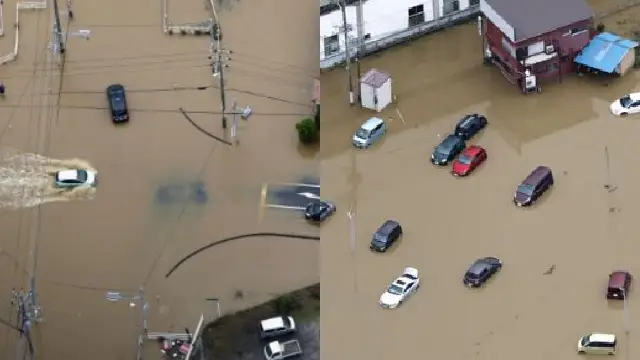
Unprecedented rain in Chiba has left at least four people dead, stranded roughly 7,000 travellers overnight at Narita airport, and driven evacuation orders covering more than 400,000 residents across eastern Japan.
The prefecture’s governor, who has managed numerous disasters over his career, said he had never encountered anything comparable.
What Fell and How Fast
The torrential rain struck Chiba prefecture, east of Tokyo, on Thursday night.
The intensity is the detail that explains everything else. Rainfall reached 115mm per hour — approximately the volume the region would normally record across the entire month of August.
Infrastructure designed for monthly accumulation does not absorb monthly accumulation delivered in sixty minutes. Drainage systems back up. Roads become channels. Water finds routes it was never meant to take.
A First for the Prefecture
The Japan Meteorological Agency issued its highest-tier level 5 warning for heavy rain and landslides — the first time that designation has ever been applied to Chiba.
Level 5 is not a caution. In Japan’s warning framework it signals that a disaster is either imminent or already occurring, and that safe evacuation may no longer be possible.
The Casualties
Four deaths have been confirmed, and vehicles feature in most of them.
In Ichikawa City, the body of a man believed to be in his sixties or seventies was recovered from a flooded road.
In Sakura City, a 66-year-old woman died after her car became trapped in floodwater.
Two additional people are reported to have died when they could not escape their vehicles as water rose around them.
That pattern is grimly consistent with flash flooding worldwide. Cars offer a false sense of security, and by the time water depth becomes obvious, doors are frequently impossible to open against the pressure outside.
Soldiers have been deployed to assist with relief operations.
Where People Sheltered
The disruption produced two large concentrations of displaced people.
Around 7,000 passengers spent the night at Narita, one of Tokyo’s principal international gateways.
A further 1,700 took refuge in the Chiba prefectural government building.
Roughly 45,000 homes lost electricity as the storm passed through, and landslide warnings accompanied the rainfall across the affected area.
Scenes From the Storm
Footage broadcast by NHK captured the force involved. In Chiba’s central ward, water erupted from what appeared to be a maintenance hole, spurting higher than an adjacent five-storey building.
That image conveys something statistics cannot. Water rising through a drainage system at that pressure indicates a network overwhelmed to the point of reversal — the infrastructure no longer removing water but expelling it upward.
The Governor’s Assessment
Chiba Governor Toshihito Kumagai addressed reporters on Friday morning, describing the situation as extremely unusual.
He noted that despite responding to many disasters over the years, he had never experienced anything of this character.
Coming from an official in a country with extensive disaster experience, that assessment carries weight. Japan is among the most thoroughly prepared nations on earth for flooding, earthquakes and typhoons. Systems that routinely handle severe weather were pushed beyond their design.
The Danger Has Not Passed
Rainfall eased by Friday, but authorities were emphatic that the risk remains active.
Kazuhito Shimamoto of the ministry of land, infrastructure, transport and tourism issued direct guidance to residents near waterways.
For rivers already carrying high flood risk, he urged people to take whatever action they could to protect their lives. He added that some rivers face increasing risk in the hours ahead, and advised residents to check evacuation advisories from their local municipalities and to leave early rather than wait.
That warning reflects how river flooding works. Rain falling across a catchment takes time to reach the main channels. Peak river levels frequently arrive well after the rain itself has stopped — which is precisely when public attention tends to relax.
The Climate Dimension
Japanese meteorologists have been clear that climate breakdown is driving both the frequency and severity of extreme weather events.
The physical mechanism is well established. Warmer air holds more moisture, meaning storms have more water available to deposit and can release it at higher rates.
Events like this one — a month’s rain compressed into an hour — are exactly what that mechanism produces.
What Comes Next
Immediate priorities are search and relief operations, restoration of power to the remaining affected homes, and monitoring of river levels through the weekend.
The longer question concerns infrastructure. Drainage systems, flood defences and evacuation planning are all built around historical rainfall records. When a level 5 warning arrives somewhere it has never been issued before, those records stop functioning as a reliable guide to what needs to be prepared for.
Chiba’s recovery will take weeks. The recalculation it prompts may take considerably longer.
Author
-
Lucienne Albrecht is Luxe Chronicle’s wealth and lifestyle editor, celebrated for her elegant perspective on finance, legacy, and global luxury culture. With a flair for blending sophistication with insight, she brings a distinctly feminine voice to the world of high society and wealth.