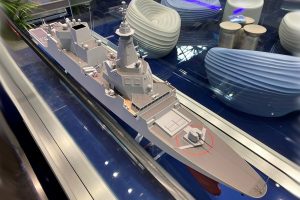
Fincantieri FREMM EVO Pitch Aims to Win Back U.S. Navy Frigate Role After Constellation Collapse
The Fincantieri FREMM EVO could soon be back on the U.S. Navy’s radar. Fincantieri Marine Group, the shipbuilder behind the cancelled Constellation class frigate, says it sees a fresh opportunity as the Navy once again searches for ready-to-build warship designs from abroad. The company wants its newest frigate design added to the list of options now under review, arguing that its existing American shipyard and supply chain could get vessels to the fleet quickly.
Whether the Navy is willing to return to the same builder, and essentially the same parent design, after one of its most troubled programs in recent memory remains a very open question.
The Navy Is Looking Abroad Again
The Navy is currently studying at least three foreign frigate designs for possible service, along with the option of building some of them overseas. A review of these options is expected to conclude next month. The designs reportedly under consideration are:
- Japan’s Mogami class
- South Korea’s Chungnam class
- Turkey’s Istanbul class
This effort stems from a presidential memo issued in August. It instructed the Navy to develop a plan, including timelines and resources, for a new competitive approach to buying surface combatants capable of hunting submarines, fighting surface ships and escorting convoys.
The Finland Model
The memo also introduced an acquisition strategy known as the “Finland Model.” Under this approach, foreign shipbuilders winning contracts would need to invest heavily in American businesses and employ U.S. workers, even if the first batch of ships is constructed abroad.
What Went Wrong With Constellation
The Constellation class was based on the Franco-Italian FREMM, a multi-role frigate built to handle air, submarine and surface threats. The idea was to take a proven design already in production and make only minor changes, keeping costs and risks low.
That plan fell apart. By the end, the Constellation shared only about 15 percent of its design with the original FREMM. The constant modifications led to delays and other problems that ultimately contributed to the program’s cancellation.
While the Navy itself played a major role in those design changes, Fincantieri’s association with the failed program could still weigh on any new bid.
Fincantieri’s New Pitch
Fincantieri CEO George Moutafis believes the company can avoid a repeat. In a recent interview, he suggested the Navy and the administration could work with the shipbuilder to set up production quickly, provided they stick with the existing design rather than reshaping it endlessly. His message was simple: take a design that already works and start building it.
He also said the supply chain created for the Constellation program could be adapted to support the FREMM EVO with only minor adjustments.
Lessons Learned
Moutafis has previously argued that the Constellation experience is already changing how the Navy operates. He pointed to reforms that give Portfolio Acquisition Executives more power to make decisions, limit design changes and embrace new technology.
In his view, the Navy needs to decide what matters most, especially delivery schedules, and then empower leaders to make trade-offs. Chasing perfection, he suggested, can get in the way of producing ships that are good enough to support sailors heading into danger.
Inside the FREMM EVO
Fincantieri unveiled the FREMM EVO in 2024, alongside an order for two ships from the Italian Navy. In July this year, Portugal announced plans to buy three.
Key Specifications
- Length: roughly 144 metres
- Beam: about 19.7 metres
- Full-load displacement: around 6,500 tons
The hull is largely unchanged from Italy’s version of the original FREMM, but the ship features a redesigned superstructure and a range of new capabilities.
Advanced Radar and Missile Defense
The standout upgrade is Leonardo’s Kronos Dual-Band Radar, which combines C-band and X-band systems using four pairs of active electronically scanned arrays. Merging radar data in this way can deliver sharper target tracking and allow multiple tasks at once, though dual-band radars have historically been difficult to integrate and operate.
The new radar will enable the ship to intercept ballistic missiles in their final phase of flight using Aster 30 missiles. With anti-ship ballistic missiles becoming a growing threat worldwide, this is an increasingly valuable capability.
The ship carries 16 vertical launch cells, with room set aside for more.
Weapons and Systems
The FREMM EVO’s armament includes:
- Launchers for eight anti-ship cruise missiles
- Two triple torpedo tube mounts
- Two 76mm gun turrets
- Various smaller cannons and machine guns
It also features upgraded sensors, electronic warfare and communications systems, all managed through Leonardo’s SADOC 4 combat management system. A dedicated counter-drone suite, using AI-powered algorithms to detect and disrupt drones, adds protection against one of today’s fastest-growing threats.
The FF(X) Factor
Any new frigate buy would sit alongside the Navy’s existing FF(X) program. That frigate is based on Huntington Ingalls Industries’ Legend class National Security Cutter used by the Coast Guard.
Notably, the FF(X) will initially lack vertical launch cells, relying instead on containerised weapons and uncrewed surface vessels to boost its firepower. The design recently passed its critical design review, and the Navy hopes to have the first ship in the water by 2028.
Rear Admiral Casey Moton, who leads the Navy’s maritime acquisition office, said the service is examining all options but declined to predict which path it will take.
Why the Navy Needs More Frigates
Demand for smaller warships remains strong. Rear Admiral Brian Metcalf has noted that the Navy’s Arleigh Burke class destroyers are in constant demand and that the fleet cannot rely on a single ship size. Frigates can take on escort duties and operate in less contested waters, freeing destroyers for high-end missions.
Obstacles Ahead
Several hurdles could complicate Fincantieri’s return:
- Some lawmakers strongly oppose building Navy ships in foreign yards
- U.S. shipyard capacity remains limited
- Fincantieri’s Marinette Marine yard in Wisconsin is already building Medium Landing Ships for the Navy
- The optics of returning to the same builder and parent design may be unappealing
A domestic build offer at Marinette could appeal to critics of overseas construction, but it could also stretch shipyard resources already tied to other programs.
What Comes Next
The Navy’s ongoing review should offer a clearer picture of its plans. Whether Fincantieri gets a second chance may depend on whether the service believes it can finally resist the design changes that sank the Constellation, and whether the FREMM EVO can prove that sticking with a proven design is the fastest way to put new frigates to sea.
Author