Title: Serbia Anti-Government Protests 2026: Tens of Thousands Demand Early Elections in Belgrade
Focus Keyword: Serbia Anti-Government Protests 2026
SEO Tags: Serbia Anti-Government Protests 2026, Belgrade rally, Vucic early elections, Novi Sad rail disaster, Serbian student movement, EU Serbia tensions, Balkan political crisis, Slavija Square protests, anticorruption movement, Serbia news today
SEO Meta Description: The Serbia Anti-Government Protests 2026 saw tens of thousands rally in Belgrade as student-led movements demand early elections and accountability from President Aleksandar Vucic.
Suggested URL: /serbia-anti-government-protests-2026
Article:
Serbia Anti-Government Protests 2026: Tens of Thousands Demand Early Elections in Belgrade
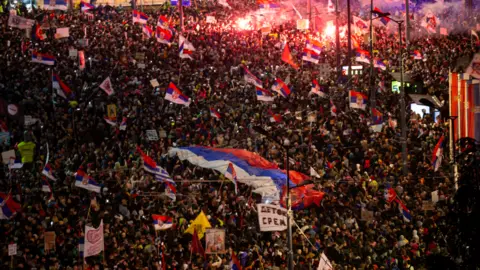
The Serbia Anti-Government Protests 2026 have once again drawn the world’s attention to the streets of Belgrade. Tens of thousands of demonstrators, led by an energetic university student movement, gathered in the Serbian capital to demand early elections and call for greater government accountability. With the protests growing larger and the political climate becoming increasingly tense, Serbia finds itself in one of its most significant moments of civic mobilization in recent years.
The demonstration is part of a broader, months-long movement that has reshaped the country’s political conversation and put President Aleksandar Vucic under increasing pressure.
A Movement Born From Tragedy
The roots of these protests stretch back to the devastating Novi Sad rail station disaster in November 2024, which killed 16 people. The incident sparked national outrage and triggered widespread anticorruption protests, with citizens demanding a fully transparent investigation into the events leading up to the disaster.
The fallout from the tragedy was massive. Then-Prime Minister Milos Vucevic resigned amid public pressure, and the political environment began shifting rapidly. What started as a grassroots anticorruption movement soon evolved into a powerful student-led campaign aimed at challenging the very foundation of the ruling government.
“Students Win”: A New Generation Leads the Charge
The streets of Belgrade have become a stage for a generation of young Serbians who believe their country deserves better governance. Many of the demonstrators wore T-shirts and held banners stamped with the slogan “Students win,” signaling both the unity and growing influence of the youth-led movement.
People streamed in from across Serbia, with cars filling the streets of Belgrade and protesters carrying flags representing different cities. Their determination was unmistakable.
Maja Milas Markovic, one of the protesters, expressed her hope for a normal future, praising the students for inspiring people to come together. She emphasized that their energy has rekindled belief in democratic values across the country.
The student movement’s strength lies in its commitment to nonviolence, its grassroots approach, and its ability to mobilize broad public support without relying on traditional political parties.
Vucic Faces Mounting Pressure
President Aleksandar Vucic, who has been at the center of Serbia’s political life for over a decade, now faces one of the most challenging moments of his career. While he has historically maintained a strong grip on Serbia’s political institutions, the rising public dissent has begun cutting into his support base.
Earlier this week, Vucic announced that early elections could be held between September and November 2026. Critics see this announcement as a partial concession to the growing pressure, though many believe it does not go far enough to address public demands for systemic reform.
Vucic has also taken a confrontational stance toward the protesters. He, along with his government and pro-government media, has often labeled critics as “terrorists” and “foreign agents,” intensifying political polarization. The aggressive rhetoric has only fueled tensions between his supporters and the protest movement.
Government Counters With Disruption
In an effort to limit participation, Serbia’s state railway company canceled all trains to and from Belgrade on Saturday. The move was widely seen as an attempt to prevent demonstrators from neighboring towns and regions from joining the protest. Despite the obstacles, thousands made the journey by car and arrived in massive convoys, bringing energy and momentum into the city.
This was not the first time the government has been accused of using strategic measures to influence the size or impact of protests. Critics argue that such moves only deepen public mistrust.
Sporadic Clashes Erupt in Belgrade
While the protest remained largely peaceful, sporadic clashes broke out between demonstrators and police near the presidency building and around a park where Vucic’s supporters have been camping since March 2025.
Police responded to certain protest movements with:
- Tear gas
- Stun grenades
- Crowd dispersal tactics
- Reinforced lines to push protesters away from sensitive locations
Some protesters set fire to garbage bins, sending plumes of smoke through parts of the city. Although the protests have remained mostly peaceful overall, fears of escalation continue to loom, especially due to past attacks on student demonstrators by masked, pro-government groups.
A Movement Without a Clear Leader
The Serbian protest movement is broad, deeply organized, and powered by young citizens. However, journalists and political analysts argue that the movement faces important challenges, particularly its lack of a clear political leader or unified policy platform.
Belgrade-based journalist Tetyana Kekic noted that the protests enjoy enormous public support due to their all-encompassing approach to challenging the government. Still, she pointed out that the absence of a strong leader makes it more difficult for the movement to compete politically with Vucic.
This dynamic creates a fascinating moment in Serbian politics. While the protests are powerful and widespread, transitioning that energy into a coherent political force remains the next major challenge.
International Spotlight Grows
The protests have placed Serbia under intense international scrutiny. Council of Europe Commissioner for Human Rights Michael O’Flaherty recently criticized the Serbian government and announced that he would closely monitor developments in the country. His remarks add weight to the growing international concern over Vucic’s handling of dissent.
Serbia is also officially seeking entry into the European Union. However, the country’s political path has been complicated by:
- Close ties with Russia and China
- Allegations of democratic backsliding
- Concerns about media freedom
- Heavy-handed responses to dissent
- Increased polarization in the political landscape
The EU’s top enlargement official warned last month that Serbia could lose up to 1.5 billion euros in European Union funding due to ongoing democratic concerns. This places enormous economic and diplomatic pressure on the Serbian government to address the demands of the protest movement.
Slavija Square: A Symbolic Venue
The protests on Saturday took place at Belgrade’s Slavija Square, the same location that hosted a massive antigovernment protest in March 2025. That earlier demonstration ended in a sudden disruption that experts later said may have involved the use of a sonic weapon — an allegation the government has firmly denied.
The historical weight of the venue has made it a powerful symbol of resistance and civic action. Today, Slavija Square represents the heart of the protest movement and the desire of many Serbians to reclaim their democratic future.
The Road to Elections
As Serbia heads toward upcoming elections later this year or in early 2027, the political stakes are unusually high. Students and other protesters are determined to challenge the ruling party and use the upcoming vote to shift the country’s political direction.
While Vucic remains a dominant force in Serbian politics, the energy and persistence of the youth-led movement suggest that the country may be on the verge of a major political shift. Whether this energy translates into electoral success remains the central question.
Final Thoughts
The Serbia Anti-Government Protests 2026 represent more than just a moment of public unrest. They reflect a deep desire for political renewal, transparency, and democratic accountability. From the tragedy in Novi Sad to the booming “Students win” movement, the protests have transformed Serbia’s political environment in a way that few imagined just two years ago.
As tensions rise and elections approach, Serbia stands at a crossroads. The student movement may not have a single leader or political platform, but its message is unmistakable: the country’s youth want a future built on integrity, fairness, and democratic strength.
The world will be watching closely as Serbia navigates one of the most consequential chapters in its modern history.
Author