US Strikes Iranian Military Site as Fragile Ceasefire Hangs in the Balance
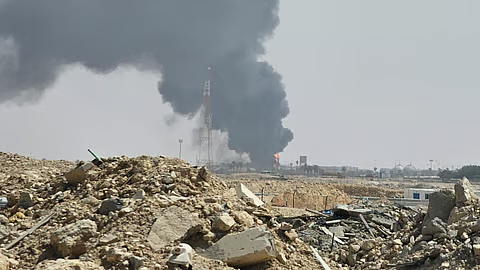
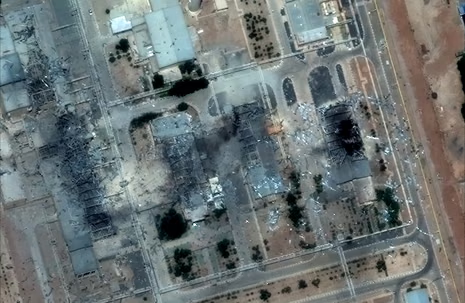
Tensions between Washington and Tehran flared dramatically once again as the US strikes Iranian military site in Bandar Abbas, a strategically vital port city. In direct response, Iran’s Islamic Revolutionary Guard Corps (IRGC) announced that it had retaliated by targeting an American air base, though it offered no specifics about the location.
The exchange marks a dangerous new chapter in an already volatile conflict, threatening to unravel a delicate ceasefire that both nations have struggled to maintain.
A Targeted Strike and a Swift Response
According to US Central Command (Centcom), the site in Bandar Abbas was hit just as it was preparing to launch a fifth drone. Iranian media reported that explosions were heard to the east of the city following the strike.
Centcom was careful to frame the operation as restrained, describing its actions as measured, purely defensive, and aimed at preserving the ceasefire rather than escalating the conflict. The command also reported that its forces shot down four Iranian one-way attack drones that posed a threat near the Strait of Hormuz.
This is now the second time in just three days that the US has struck Iranian targets, with Washington insisting each time that the actions were taken in self-defense.
Iran Vows Retaliation
Iran did not take the latest strikes lightly. Officials in Tehran condemned the attack as a serious breach of the ceasefire and vowed that no act of hostility would go unanswered.
The IRGC’s claim that it had targeted a US air base added to the sense of escalation, even without confirmed details. Adding further uncertainty, Kuwait, which hosts an American air base, reported that its air defenses were intercepting hostile missile and drone threats, though it stopped short of identifying where the threats originated.
The IRGC also claimed earlier in the week that it had downed a US drone and fired on a fighter jet and another drone that allegedly entered Iranian airspace, though it did not specify exactly when these incidents occurred.
A Pattern of Escalating Strikes
The current strike follows a previous round of US military action earlier in the week. On Monday, Washington confirmed it had carried out self-defense strikes on southern Iran, targeting:
- Iranian missile sites
- Boats reportedly attempting to lay mines in the Strait of Hormuz
Centcom explained that those operations were intended to shield American troops from threats posed by Iranian forces. The Strait remains heavily affected by the conflict, with thousands of commercial tanker ships stranded as a result.
Economic Pressure and the Battle Over the Strait
Beyond the military exchanges, the conflict has spilled into the economic arena. The US imposed sanctions on the so-called “Persian Gulf Strait Authority,” the Iranian body responsible for collecting payments from ships passing through the Strait of Hormuz.
The US Treasury Department warned that any vessels paying fees to this authority could themselves face the risk of sanctions. US Treasury Secretary Scott Bessent characterized the arrangement as the Iranian military’s latest effort to extort global maritime trade and offered it as evidence that Iran is desperate for cash.
Tehran pushed back on this framing. Iranian foreign ministry spokesman Esmaeil Baqaei said the country was simply collecting fees for navigational services and would continue managing traffic through the waterway.
The stakes here are enormous. About one-fifth of the world’s liquefied natural gas and oil normally flow through this shipping channel, and its disruption has sent ripples through the global fuel trade, pushing energy prices sharply higher.
Negotiations Hang by a Thread
Against this backdrop of military and economic conflict, drawn-out negotiations have been underway to bring an end to the three-month war. The fighting has choked traffic through the Strait of Hormuz and driven global energy costs upward, adding urgency to the diplomatic effort.
President Donald Trump struck a notably hard tone during a cabinet meeting on Wednesday. He claimed that Iran was “negotiating on fumes” and insisted that his war strategy would not be swayed by the upcoming November US midterm elections.
“Maybe we have to go back and finish it, maybe we don’t,” Trump said, leaving the door open to renewed military action.
Mixed Signals on a Possible Deal
The path toward peace has been anything but smooth. Just over the weekend, Trump sounded optimistic, suggesting that a deal with Iran had been “largely negotiated.” By Wednesday, however, his tone had shifted considerably, as he declared that the US was “not satisfied” with the current state of talks.
The confusion deepened when Iranian state television reported details of what it described as a draft agreement. According to that report, the proposed terms included reopening the Strait of Hormuz and withdrawing US forces from the region. The White House quickly dismissed the document as a “complete fabrication.”
Both sides had signaled progress late last week, fueling speculation that an announcement might be near. Yet Tehran soon cautioned that a deal was “not imminent,” while Trump said he had instructed his negotiators not to rush the process.
Trump’s Ultimatum
Trump’s remarks made clear that Washington is prepared to apply maximum pressure. He expressed confidence that Iran ultimately wants an agreement, saying he didn’t think Tehran had much choice in the matter.
At the same time, he reiterated his willingness to escalate if necessary. Trump suggested that while Iran appeared intent on reaching a deal, they hadn’t yet arrived at acceptable terms, warning that the alternative would be to “finish the job.”
During the same cabinet meeting, the president also urged Gulf nations to join the Abraham Accords and normalize relations with Israel. Israel, which launched the war against Iran alongside the US on 28 February, remains entangled in a separate conflict with the Iranian-backed Hezbollah in Lebanon.
What Lies Ahead
As the US strikes Iranian military site and Iran responds with claims of its own retaliation, the fragile ceasefire appears increasingly precarious. With negotiations stalled and both sides trading threats, the risk of a broader escalation looms large.
For now, the world watches closely, aware that the outcome will shape not only the future of the region but also the stability of global energy markets. Whether diplomacy can prevail or whether the conflict reignites in full force remains an open and pressing question.
Author