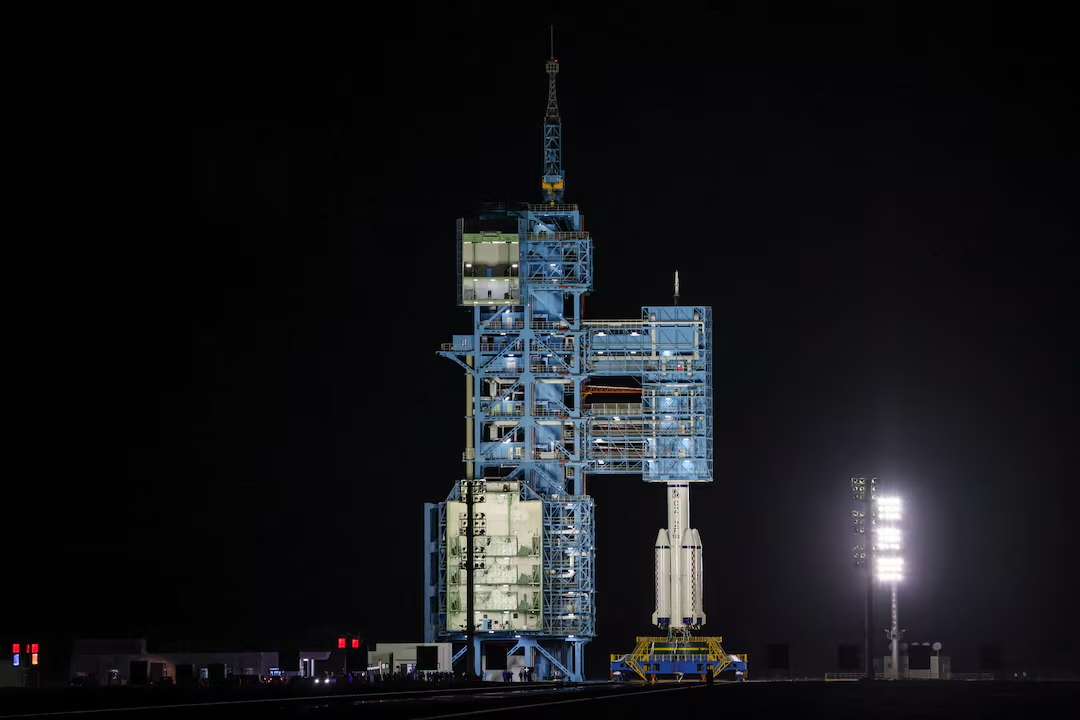
Shenzhou 23 Spacecraft Launch Marks Another Milestone for China’s Space Ambitions
The Shenzhou 23 spacecraft launch has once again placed China firmly in the global space spotlight. On Sunday night, the spacecraft lifted off from the Jiuquan Satellite Launch Center in northwestern China, carrying three astronauts toward the country’s Tiangong space station. The mission is significant on several fronts. It includes the first astronaut from Hong Kong, an ambitious yearlong stay in orbit for one of the crew members, and continued momentum toward China’s planned crewed moon landing by 2030.
For China’s space program, this launch is more than just another routine flight. It represents a steady push toward becoming one of the dominant players in space exploration, even as competition with the United States intensifies.
Meet the Three Astronauts on Board
The Shenzhou 23 mission is led by commander Zhu Yangzhu and joined by fellow astronauts Zhang Zhiyuan and Lai Ka-ying. Lai, also referred to by her Mandarin transliterated name Li Jiaying, has captured public attention as the first astronaut from Hong Kong to take part in a Chinese space mission. Born and raised in the city, she also holds a doctoral degree in computer forensics, adding a unique academic profile to the crew.
The trio is expected to take part in a wide range of scientific experiments and applied research projects during their time aboard the Tiangong space station. According to state media, they will also complete an in-orbit rotation with the crew of Shenzhou 21, who have already been at the orbiting station for more than 200 days.
A Yearlong Stay in Space
One of the most attention-grabbing details of the Shenzhou 23 mission is the plan for one of the astronauts to remain in space for a full year. If completed successfully, this would rank among the longest single stays in space ever attempted.
The goal of the extended mission is to study how the human body and mind respond to long-duration spaceflight. State media reported that the astronaut’s task is to “explore human adaptability and performance limits” in such challenging environments. This type of research is critical as China prepares for deeper space missions, including future lunar and possibly Martian exploration.
Some of the areas likely to be studied include:
- Long-term effects of microgravity on muscles and bones
- Psychological impacts of extended isolation
- Cardiovascular and immune system responses
- Sleep cycles and cognitive performance over time
- Practical workflows for extended space habitation
Building Toward the 2030 Moon Mission
The launch comes at a strategic moment for China. The country has openly set its sights on landing astronauts on the moon by 2030, and every mission to Tiangong is a stepping stone toward that bigger goal. By practicing long-duration stays, crew rotations, and complex science operations, China is steadily building the foundation it needs for crewed lunar exploration.
The United States, however, is not far behind in the race. NASA has its own ambitious plans, aiming to put astronauts back on the moon by 2028 through the Artemis program. With both nations advancing in parallel, space watchers say the next several years could redefine global leadership in space.
A Brief History of China’s Space Station
China’s Tiangong space station, whose name translates to “Heavenly Palace,” welcomed its first crew in 2021. Since then, it has become a central hub for China’s growing space activities. The station was developed in part because China was effectively shut out of the International Space Station due to national security concerns raised by the United States.
Rather than slowing China down, that exclusion seems to have sparked a determined push to build an independent presence in low Earth orbit. The Tiangong now stands as proof of how far the country has come in just a few years.
Some quick highlights of the Tiangong’s journey include:
- First crew arrival in 2021
- Continuous expansion and upgrading of modules
- Multiple successful astronaut rotations
- Increasing scientific output from on-board experiments
- A growing list of international partnerships
A Reminder of Recent Risks
While the Shenzhou program continues to make headlines for its progress, it also serves as a reminder of the very real dangers involved in space travel. Just last year, an emergency mission within the Shenzhou program had to bring back a team of astronauts who were stranded on the space station after their spacecraft was damaged.
That incident underscored both the risks of space exploration and the technical capability China has built up to handle complex rescue operations. It also reinforced the need for redundant systems and rapid-response procedures as missions become longer and more ambitious.
Why This Mission Matters Globally
The Shenzhou 23 mission is not just a domestic achievement. It carries weight on the international stage as well. With astronauts from diverse backgrounds, including the first from Hong Kong, the mission sends a message about inclusivity within China’s space program. It also reflects how serious Beijing is about long-duration human spaceflight research.
Here are a few reasons why the international community is watching closely:
- China is rapidly closing the gap with established spacefaring nations
- The Tiangong station could become a key alternative to the aging ISS
- Long-duration mission data has applications worldwide
- Cooperation and competition will shape the next decade of space policy
- New astronauts from regions like Hong Kong may signal expanding participation
The Astronauts of Tomorrow
Lai Ka-ying’s selection has already inspired conversations across Hong Kong and beyond. Her academic background in computer forensics is unusual for an astronaut, but it highlights how varied the skills required for modern space missions have become. Today’s space crews are not just pilots. They are scientists, engineers, researchers, and explorers all rolled into one.
Her presence on the mission could also encourage young people from cities across China and Asia to see space as an attainable career. For many in Hong Kong, watching one of their own represent the city in orbit is being seen as a proud and historic moment.
Looking Ahead
The Shenzhou 23 spacecraft launch is more than just another date on China’s expanding space calendar. It is a snapshot of where the country is heading and how confidently it is moving forward. From training the first Hong Kong astronaut to studying the limits of human endurance in space, this mission is packed with firsts and ambitious goals.
As the crew settles into life aboard Tiangong and begins their experiments, the world will be watching to see what discoveries come from the months ahead. Whether it is groundbreaking research, new technological achievements, or simply inspiring stories from orbit, this mission has the potential to shape the next chapter of China’s space journey, and possibly the global space landscape too.
Author