Spain Train Crash Near Urda: Nation Mourns as 68 Die in Second High-Speed Rail Disaster of the Year
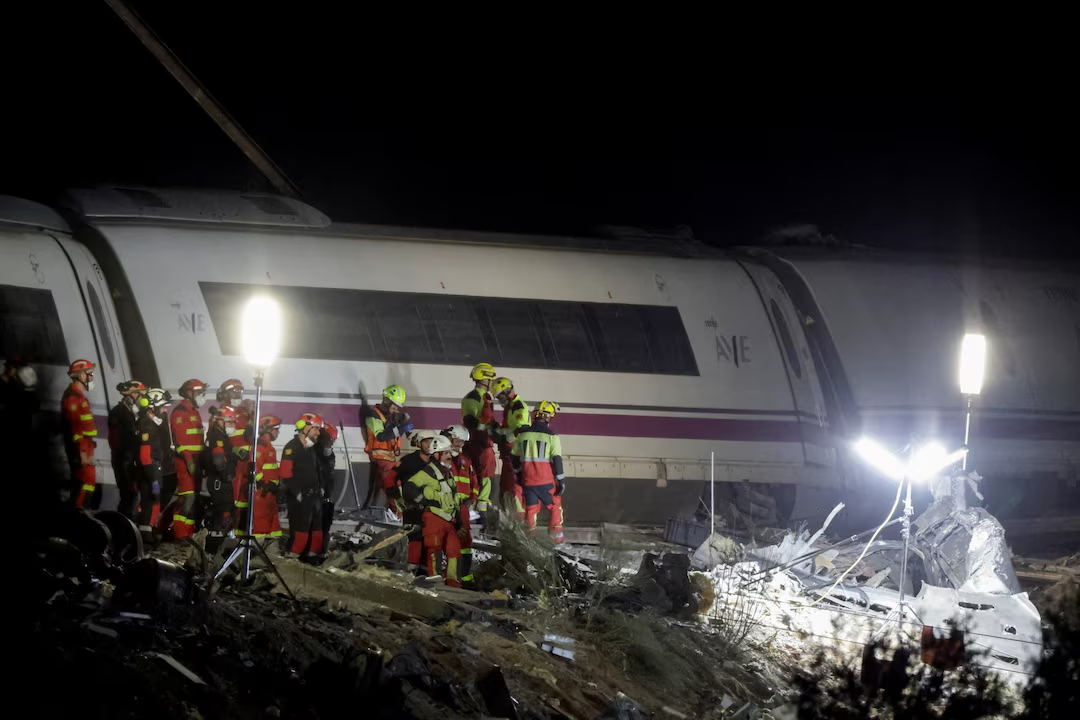
The Spain train crash that struck the Madrid to Andalusia line on Wednesday morning has left 68 people dead and plunged the country into three days of official mourning. The collision, which involved trains from two different operators, is the second deadly high-speed rail accident Spain has suffered in less than a year, and it has reopened a painful debate about the state of the nation’s railway infrastructure.
What Happened on the Madrid to Andalusia Line
Two trains were running in the same direction along the busy corridor linking the capital with the south of the country. One belonged to Renfe, the state-run operator, while the other was run by Iryo, a private company that competes on the same route.
According to officials, the Iryo service had stopped on the track for reasons that remain unclear. Moments later, the Renfe train struck it from behind. The force of the impact threw several carriages off the rails near Urda, a small town in the Castilla-La Mancha region roughly 130 kilometres south of Madrid.
The human toll was devastating. Beyond the 68 confirmed deaths, around 107 passengers required hospital treatment, and at least 15 of them were listed in serious condition by Wednesday evening.
A Grim Overnight Search Through the Wreckage
Rescue teams worked without pause through the night. Heavy cranes were brought in to lift twisted sections of metal so that crews could reach the areas beneath and between the overturned carriages. The work was slow and dangerous, and officials cautioned that the final death count could still climb.
Emiliano García-Page, who heads the regional government of Castilla-La Mancha, told reporters that teams had not yet been able to access the lowest parts of the derailed cars, meaning further victims might still be found.
Helping Families Find Answers
For hundreds of relatives, the hours after the Spain train crash were defined by uncertainty. Many travelled to the area with little information, hoping to learn whether their loved ones had survived.
To manage the identification process, the Civil Guard opened four dedicated centres in Madrid, Toledo, Córdoba and Seville. At these offices, family members can give DNA samples that will be matched against unidentified victims. Blood donation stations were also set up across Castilla-La Mancha and the Madrid region to support the hospitals treating the injured.
In Urda itself, a local school was converted into an information point where families could ask about missing passengers. Red Cross volunteers were on hand to offer emotional support, and many of those who arrived were visibly distraught.
Carmen Garcia, a psychologist working with the Red Cross, described the difficult days ahead. She explained that reactions varied widely: some people were in shock and had not yet absorbed the news, others were angry, and many were simply frightened and sad. Grief, she noted, would not follow a single pattern, and the process of coming to terms with the loss would be long and complicated for everyone involved.
The First Victims Identified
Among the earliest names released was José Manuel Chacón, a 31-year-old officer with the Guardia Civil. The force issued a statement expressing deep sympathy to his relatives, friends and fellow officers.
Spanish media reported that a former minister from the People’s Party was among those unaccounted for. Several foreign nationals, believed to have been visiting the country as tourists, were also listed as missing.
A Troubling Pattern: Echoes of the Adamuz Disaster
What makes this tragedy especially alarming is that it is not an isolated event. In January, 46 people lost their lives and many more were injured when two trains collided near Adamuz in Andalusia. That crash occurred on the very same line, and it too involved a Renfe service and an Iryo service.
The similarities between the two incidents have not gone unnoticed. Two fatal collisions on one corridor within the span of a single year have raised serious doubts about whether Spain’s high-speed network, long regarded as one of Europe’s best, is being properly maintained and managed.
Government Response and Promises of Accountability
Prime Minister Pedro Sánchez did not attempt to downplay the seriousness of the situation. He said that it was simply not acceptable for a country like Spain to experience two high-speed rail disasters in the same year.
The prime minister confirmed that a full investigation was under way. He pledged that if investigators found evidence of failures in the signalling or safety systems, or any sign of negligence, those responsible would face the strictest possible consequences.
The transport minister, meanwhile, had earlier described the circumstances as involving an “error” and conditions that could not yet be explained. That language has only heightened public concern, since it suggests that the cause may lie in the systems designed to prevent exactly this kind of accident.
Opposition Demands a Full Network Review
The political reaction has been swift. Alberto Núñez Feijóo, leader of the opposition People’s Party, called for an immediate inquiry into the Urda crash. He went further, demanding a complete and independent review of the entire Spanish rail network.
Feijóo argued that citizens deserve to know what is happening with the infrastructure they rely on every day. His comments reflect a growing sense that reassurances are no longer enough and that a thorough, transparent examination is needed to restore public trust.
Questions That Need Answers
Several key questions remain unresolved:
Why did the Iryo train come to a stop on the line?
Why was the Renfe train not warned or halted before the collision?
Did the automatic safety systems on the track function as intended?
Were there communication failures between the two operators or with the network controller?
Until investigators can answer these questions, the public will be left wondering whether travelling on one of Spain’s most important rail routes is as safe as it once seemed.
A Country in Mourning
For now, Spain is focused on grieving. Flags are flying at half-mast, and communities across the country are holding vigils for the victims. Families continue to wait at the school in Urda and at identification centres, hoping for news that will bring some measure of closure.
The Spain train crash near Urda will be remembered not only for the lives it took, but also for the hard questions it forced the country to confront about safety, oversight and accountability on its railways.
Author