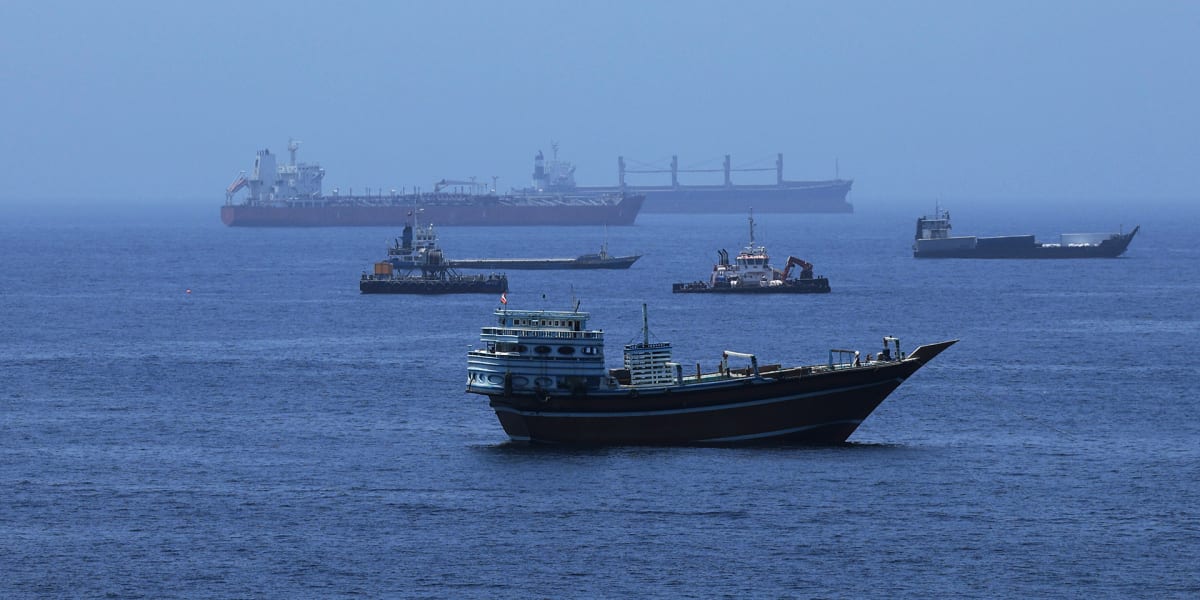
The Strait of Hormuz has become the central bargaining chip in an increasingly bitter standoff between Washington and Tehran, with both sides now demanding that the other pay for the damage caused by their war. What began as a dispute over reopening a shipping lane has hardened into a contest over blame, money, and who ultimately controls one of the most important stretches of water on the planet.
Trump Says the Waterway Is Under American Control
Speaking to reporters in the Oval Office, Donald Trump declared that the passage is functioning again and that American forces are the only party currently in command of it. He said the US Navy had swept mines from the channel and that Washington now holds what he described as complete control.
Iran tells a different story. Officials in Tehran insist the route stays closed until the United States satisfies a list of conditions, and there has been no indication from the Iranian side that those terms have been relaxed.
The gap between those two accounts is not a small one. One government is describing an open waterway secured by its own navy. The other is describing a deliberate closure that will hold until its demands are met. Shipping operators, insurers, and energy traders are left trying to work out which version reflects conditions on the ground.
Tehran’s Six Conditions
Iran’s senior security leadership set out a six-point framework earlier for allowing traffic to resume. Among the requirements was full payment for the destruction inflicted during the fighting, a demand Tehran presented as a precondition rather than a negotiating opening.
That framing was intended to put the United States on the defensive. Instead, it triggered a response few anticipated.
A Reversal Nobody Saw Coming
Rather than engaging with the proposal, Trump inverted it. Writing on Truth Social, he called the compensation concept interesting and said he would now be seeking payment from Iran instead. He added that his representatives had been instructed to build the demand into every future round of talks.
His claim covers a sweeping historical span. He referenced Americans killed and wounded by roadside bombs across decades of regional conflict, tied that campaign to the late General Qassem Soleimani, and specifically named the families of those who died aboard the USS Cole alongside thousands of others killed in combat.
He went further still, arguing that compensation is owed to the relatives of protesters killed inside Iran over the past half century, and citing a figure of 52,000 deaths in the most recent five-month period.
In a separate post, he broadened the accusation to include civilian suffering in Lebanon, Syria, Yemen, and Gaza, saying Iran should answer for the damage and loss of life there as well.
The practical effect is that two mutually exclusive reparations claims are now sitting on the same negotiating table. Neither side has offered a mechanism for resolving them.
Energy Markets React Immediately
Traders responded the way traders usually do when a chokepoint stops behaving predictably.
Here is where prices landed as the talks appeared to stall:
- Brent crude climbed to roughly 88 dollars a barrel
- US crude reached about 82.45 dollars
- Both benchmarks hit their strongest levels since the end of July
- The move followed a jump of around 5 per cent the previous day
The logic is straightforward. An enormous share of the world’s seaborne oil and liquefied natural gas passes through this narrow corridor. Any credible threat of prolonged disruption forces buyers to secure alternative supply, pushes insurance costs higher, and adds days or weeks to voyages that would otherwise be routine.
Traders are not pricing what happened. They are pricing what might happen next, and right now the political signals point toward delay rather than resolution.
Political Fallout at Home
The confrontation is producing sharp criticism inside American politics. Senate minority leader Chuck Schumer described the administration’s handling of the conflict as a total failure, arguing on X that the president entered an illegal war, is losing it, and has no exit route.
Schumer’s core charge was about competence rather than ideology. He said the absence of strategy, discipline, and serious negotiating capacity is putting American service members at risk while driving up costs for ordinary households. He called for the war to end and for the resulting damage to be repaired.
That framing links the foreign crisis directly to domestic economics, and rising fuel prices give the argument obvious traction.
Security Concerns Follow the President
Reports also emerged that Trump used an elaborate deception to depart Turkey after a recent summit, a manoeuvre attributed to a specific threat from Iran. Details remain limited, but the episode underlines how far the confrontation has moved beyond conventional diplomacy.
Inside Iran, the messaging has focused on holding the line. The Iranian president said the supreme leader had passed on a message emphasising unity and cohesion, language typically deployed to steady the population and discourage visible dissent during periods of external pressure.
What Happens Next
The immediate question is not really about reparations. It is about whether a functioning negotiating channel still exists.
Both governments have now attached a financial demand to any settlement, and each has framed its own claim as a matter of justice rather than bargaining. That leaves very little space for the quiet compromises that usually end maritime standoffs.
Three things are worth watching in the days ahead. First, whether independent shipping data supports the American account of an open waterway. Second, whether crude prices continue climbing or settle as traders test the risk. Third, whether any third party steps in to mediate before the dispute hardens further.
For now, the world’s most sensitive shipping lane remains caught between two competing declarations, and the global economy is absorbing the cost of that uncertainty.
Author
-
Lucienne Albrecht is Luxe Chronicle’s wealth and lifestyle editor, celebrated for her elegant perspective on finance, legacy, and global luxury culture. With a flair for blending sophistication with insight, she brings a distinctly feminine voice to the world of high society and wealth.