Congress is once again racing a calendar it keeps losing to, and the threat of a government shutdown now sits uncomfortably close to the midterm elections. The House made its move Tuesday, passing a stopgap bill to keep the lights on through Dec. 4 by a vote of 220-205.
Whether that bill survives contact with the Senate is another matter entirely. Right now, the odds don’t look good.
Why Johnson Moved Early
House Speaker Mike Johnson pushed the measure through to get ahead of a fight he could see coming. Lawmakers face a Sept. 30 deadline before the new fiscal year begins, and almost nobody in Washington believes the necessary 12 appropriations bills will be finished by then.
The reasons are familiar. Republicans in the House have struggled to hold their own conference together on spending. Over in the Senate, appropriators from both parties have been locked in a standoff over defense funding that has slowed everything behind it.
Add it up and you get a Congress running well behind schedule with a hard deadline approaching.
There’s also a political calculation here that nobody is really hiding. Republicans control the White House, the House and the Senate. If the government shuts down in the middle of an election season, voters are unlikely to spend much time parsing which chamber blocked what. The party in power tends to absorb the damage.
Democrats Refuse to Play Along
Stopgap bills usually attract at least some bipartisan goodwill, mostly because neither side wants the blame for a shutdown. This one didn’t.
House Democratic leaders came out against it before the vote. Minority Leader Hakeem Jeffries, Minority Whip Katherine Clark and Caucus Chair Pete Aguilar said the measure would hand the Trump administration even greater control over the federal budget and would fail to restrict funding for what they described as Trump’s violent mass deportation machine.
That framing tells you the dispute isn’t really about the calendar. It’s about who controls the money once the bill is signed.
The Senate Math Is Brutal
The House bill lands in the Senate with a problem it can’t solve on its own: Republicans need at least seven Democratic votes to move it forward. Nothing about Tuesday suggests those votes exist.
Sen. Patty Murray, the ranking Democrat on the Appropriations Committee, said flatly that she opposes the House resolution. Instead, she’s working with Appropriations Chair Susan Collins on an alternative stopgap that could actually attract support from both sides.
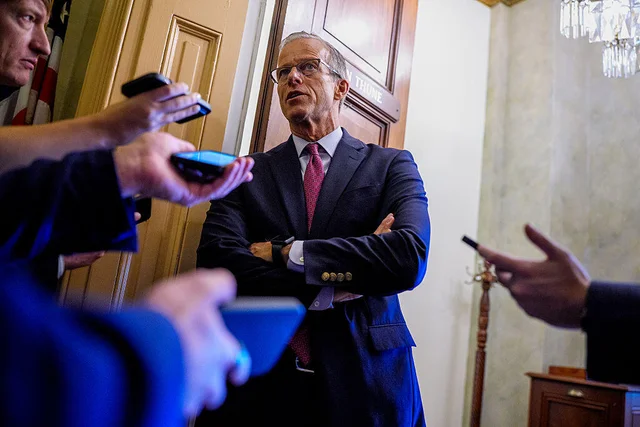
Senate Majority Leader John Thune has said he intends to bring a bipartisan funding agreement to the floor before the August recess. If that happens, the House would then have to approve it when members return at the end of the month before anything reaches the president’s desk.
That’s a tight sequence with very little margin for error.
Setting Up the Blame
House Republicans are already building their argument for what happens if the Senate stalls out.
“If the Democrats can’t support this basic principle, then they alone are going to own the chaos that ensues if the government shuts down after September 30th,” Johnson said Tuesday.
It’s a preemptive strike, and both parties are running the same play from opposite directions. The messaging is being written now, before anyone knows whether a shutdown actually happens.
A $95 Billion Package Comes Next
Funding isn’t the only item on the House GOP agenda. Republicans are moving toward a framework for a $95 billion reconciliation package, which they could pass without any Democratic votes.
The framework breaks down roughly as follows:
- $73 billion for the Pentagon, which is running short on cash largely because of the Iran war
- $12 billion for American farmers dealing with the fallout from tariffs and inflation
- $10 billion for election-related measures
Leadership wants a vote later this week, with the broader goal of getting the legislation across the finish line before the midterms.
Trump has pushed hard for this. He originally wanted something far bigger, including $350 billion in defense spending, the Save America Act with its stricter voting requirements, and $20 billion in farm aid. What’s on the table now is a fraction of that ask, but he still told House Republicans on Truth Social to vote yes.
Administration officials have been working the members directly. Office of Management and Budget Director Russell Vought met with House Republicans on Tuesday to press the case.
Conservatives Aren’t Sold
The pitch isn’t landing everywhere. Fiscal conservatives have a specific objection: the package adds new spending without any offsetting cuts, at a moment when the national debt sits at roughly $39 trillion.
Some members left Tuesday’s meeting unconvinced.
“I don’t think they’ve made a very compelling pitch,” said Rep. Tim Burchett, who argued that House leadership hasn’t done enough to prioritize legislation that would actually reduce the deficit rather than expand it.
The skepticism doesn’t stop at the House. Multiple Senate Republicans have said they either oppose the $95 billion package outright or don’t believe it can clear their chamber in any form.
What Happens From Here
Two tracks are now running at the same time, and both are wobbling.
The stopgap bill the House just passed is functionally dead in the Senate, where a bipartisan alternative is being drafted from scratch. The reconciliation package faces resistance inside the Republican conference in both chambers, which is a difficult position for a bill designed to pass on party-line votes.
The Sept. 30 deadline doesn’t move. Everything else does.
For the average person, the practical question is simpler than the procedural noise suggests. If a deal comes together, federal operations continue and this becomes another forgettable stretch of Washington brinkmanship. If it doesn’t, agencies close, workers go unpaid, and a shutdown arrives with the campaign season fully underway.
Neither party wants to own that outcome, which is usually the best reason to think something gets worked out. It’s just not a guarantee.
Author
-
Lucienne Albrecht is Luxe Chronicle’s wealth and lifestyle editor, celebrated for her elegant perspective on finance, legacy, and global luxury culture. With a flair for blending sophistication with insight, she brings a distinctly feminine voice to the world of high society and wealth.